Most people drive past Labin on their way to the beach at Rabac, four kilometres downhill. That is a mistake you can correct in half a morning. The old town sits on a ridge at 320 metres, walled, car-free in its centre, and quiet in a way the coast never is in August.
Labin is two towns, not one
The part you reach first is Podlabin — postwar apartment blocks, a supermarket, the bus station. It was built for miners. Keep going up. The old town is the walled part on top of the hill, reached by a road that narrows and then stops being a road at all.
Park below the walls and walk in. The lanes inside are barely wide enough for a car and mostly closed to them anyway. From the edge of the town you look straight down over the Kvarner bay, with Cres on the horizon and Rabac directly below.

The mine under your feet
Labin sat on coal. The mine ran until 1999, and at its peak the tunnels stretched for kilometres directly beneath the old town — which is why some of the buildings up here lean at angles that were not in the original plan. Subsidence closed parts of the town in the 1970s and emptied it; artists moved into the cheap, cracked houses, which is how a mining town became a town of studios.
The town museum has a reconstructed mine gallery in its basement, with the real equipment and the low ceilings. It takes twenty minutes and it explains everything else you will see that day.
Studios and galleries
The artists who arrived in the eighties never entirely left. Several houses in the old town have workshops on the ground floor, and in summer many keep the door open — sculpture, ceramics, prints. There is no gallery quarter as such; you find them by walking, which is the right way to see Labin anyway.
The town is small enough that you cannot get properly lost. Every lane going uphill ends at the same square.
The viewpoint over Rabac
The terrace on the seaward side of the old town gives you the whole bay: Rabac's white pebble coves, the pine slopes behind them, and on a clear day the islands of Cres and Lošinj. Late afternoon is best — the light comes from behind you and the bay turns the colour that gets photographed for brochures.
Where to stay
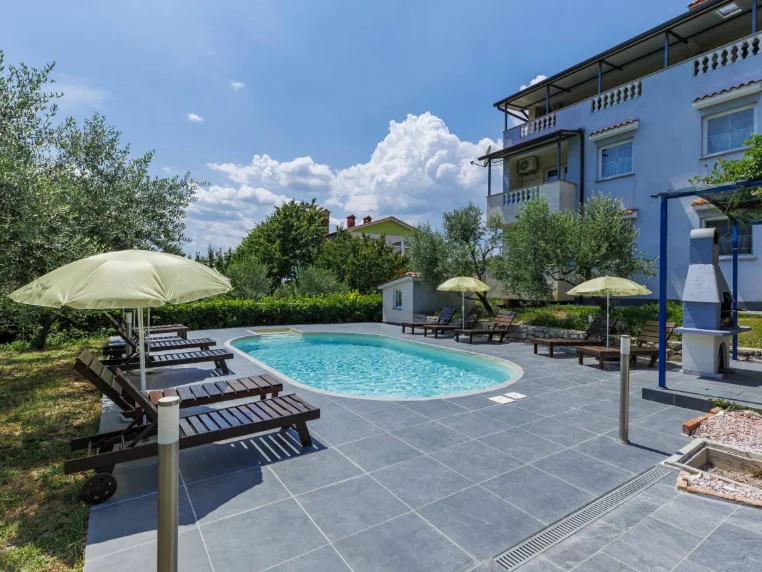
Apartment Gordana
When to go up
Morning or early evening. Between noon and four the stone holds the heat and the lanes have no shade to speak of, and you will spend the visit looking for somewhere to sit down. Out of season it can be nearly empty, which suits it.
Allow two hours for the old town, three if you go into the museum and stop for a coffee. Combine it with the beach at Rabac — down in the morning, up in the evening, or the other way round if you want the light on the bay.
Getting there
From Rabac it is four kilometres and about ten minutes by car, up a road with several switchbacks. There is a bus, and there is also a footpath — the old miners' route — which takes a little over an hour uphill and is a pleasant walk down. From Pula airport it is roughly forty minutes.
Parking is below the walls and fills up in the middle of the day in July and August. If the first car park is full, keep going: there is more space further along the ridge, and the walk back is flat.


